- Since version 1.0, a C-based Windows API has allowed programs to interact with the Windows OS
- The API has largely been tied to hardware architecture, and great care has
gone into making it backwards-compatible
- Win16 - API for the first version of Windows (running on DOS) that was 16-bit
- Win32 - for 32-bit Windows
- Win32s - subset of the Win32 API for the Windows 3.1x family
- Win64 - for 64-bit platforms
- A Hello World program (written in C using the Win32 API) is over a hundred lines of code!
- Most GUI programmers today don't write in C; they use a .NET language that encapsulates
calls to the Windows API
- Microsoft started developing the .NET Framework in 2000 and released version 1.0 in 2002
- Current version is 4.6, released in July 2015
- Initially targeted Windows OS, but Mono Project (sponsored by Novell) has supported Linux, Unix, FreeBSD, Mac OS X, Solaris
- Microsoft recently created the open source CoreCLR which targets Windows, Linux, Mac OS X, FreeBSD
- Primary languages: C#, Visual Basic .NET, Managed C++, and F#
- Third-party languages: Ada, COBOL, LISP, Perl, Python, Ruby, and many more
- CLI is an open standard created by Microsoft that describes the executable code and runtime environment that are implemented by Microsoft's .NET Framework, Mono, and Portable.NET
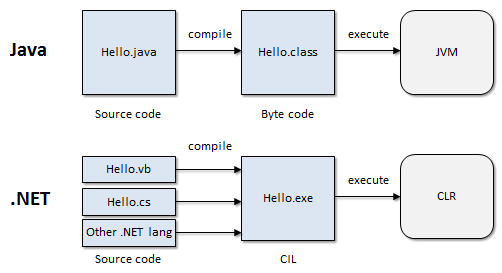
- Programs written in a CLI (or .NET) language are compiled into
Common Intermediate Language (CIL) which is sometimes called
Microsoft Intermediate Language (MSIL)
- CIL is machine-independent and does not need to be re-compiled for different platforms
- Depending on the application, the CIL is compiled into an executable (.exe), a dynamically linked library (.dll), or some other exension
- These packaged files are called assemblies
- The Common Language Runtime (CLR) is the virtual machine that executes
.NET programs (Microsoft's implementation of CLI)
- The CLR uses a just-in-time compiler (JIT compiler) to transform the CIL into machine code for the platform it is running on
- CLR handles memory management (garbage collection), type safety, and exception handling
- .NET Framework is architected much like Java
- This C# program outputs "Hello, C#!" to the console 10 times
using System; namespace HelloCSharp { class Hello { static void Main(string[] args) { for (int i = 0; i < 10; i++) Console.WriteLine("Hello, C#!"); } } } - Common practice is to save code in a file named after the enclosed
class name:
Hello.cs - Compiled into the HelloCSharp assembly
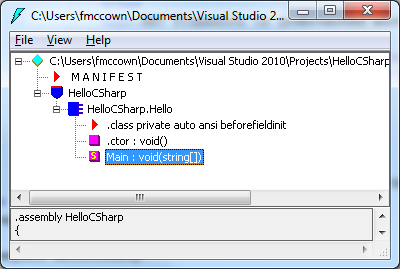
HelloCSharp.exewhich can be executed by the CLR - Can view the CIL in
HelloCSharp.exeby running theildasm(IL Disassembler) tool from theVisual Studio Command Prompt
.method private hidebysig static void Main(string[] args) cil managed { .entrypoint // Code size 30 (0x1e) .maxstack 2 .locals init ([0] int32 i, [1] bool CS$4$0000) IL_0000: nop IL_0001: ldc.i4.0 IL_0002: stloc.0 IL_0003: br.s IL_0014 IL_0005: ldstr "Hello, C#!" IL_000a: call void [mscorlib]System.Console::WriteLine(string) IL_000f: nop IL_0010: ldloc.0 IL_0011: ldc.i4.1 IL_0012: add IL_0013: stloc.0 IL_0014: ldloc.0 IL_0015: ldc.i4.s 10 IL_0017: clt IL_0019: stloc.1 IL_001a: ldloc.1 IL_001b: brtrue.s IL_0005 IL_001d: ret } // end of method Hello::Main - Because CIL can be reverse engineered, many developers use obfuscators to make reverse engineering very difficult if not impossible